

Brainstorming
1.Mind Map – Organize Your Thoughts
Write your topic in the middle and draw lines to connect subtopics, like: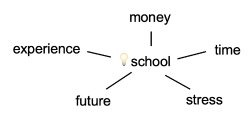
Add short notes or examples to each subtopic.
This helps you see which ideas belong together.
2. Think in Roles – Different Perspectives
Sometimes it helps to think from different points of view.
What would other people say about this topic?
A student: “I can earn my own money.”
A teacher: “It’s hard to focus on schoolwork.”
A parent: “It teaches responsibility.”
3. The “If…” Trick – Use Your Imagination
Creative questions can bring new ideas!
Example:
If you had a part-time job, what would it be?
If nobody worked during school, what would change?
4. Take one possible argument and ask “Why?” five times.
Example: Fast food should be banned in schools.
- Why? It’s unhealthy.
- Why? Too much sugar/fat.
- Why? Doesn’t keep you satisfied.
- Why is that a problem? Leads to obesity.
- Why is that important? Affects concentration and school performance.
5. “SPECS” to find different arguments
Social – how does it affect people and relationships?
Political – how do governments / laws react?
Economic – what about costs, jobs, money?
Cultural – traditions, values, identity?
Scientific / Environmental – technology, research, planet?
Handy sentence to remember: Strong People Explore Creative Solutions
1 Brainstorming 𝕊
Use the Why?-method and brainstorm “Discuss if table football should be placed in general areas of schools.”
- Why? __________________________________________________
- Why? __________________________________________________
- Why? __________________________________________________
- Why is it a problem? _______________________________________
- Why is it important? _______________________________________
| Source AG Englisch |
 Home
Home